
- Home
- /
- Multi-Location Businesses
SEO company for multiple business locations
Multi location SEO helps each of your locations show up when nearby people search. It also keeps your brand clear across every site, profile and city.
Looking for an SEO company for multiple business locations? Florida SEO Agency works as a multi location SEO agency for Florida brands. We focus on clear structure, accurate details and honest reporting.
What is it?
SEO that helps each location rank, earn trust and win local customers.
Who needs it?
Brands with two or more public locations.
What does it cover?
Site structure, local pages, profiles, listings, customer feedback and reporting.
What can it not do?
Promise rankings, leads or a place in AI answers.
Eight services
How does Florida SEO Agency Approach multi location SEO?
Our services cover the work on this page. Each one has its own focus, so you can start with the one you need.


Technical SEO
Fixes crawling, speed, site structure and markup so every location can be found.

SEO Audits
Finds problems in structure, listings, profiles and tracking before work starts.



Definition
What is SEO for multi location businesses and how is it different from single location SEO?
| Area | One Location | Many Locations |
|---|---|---|
| Website | One main page | A hub plus a clear page for each location |
| Google profile | One profile | One profile for each eligible location |
| Business details | One address and phone number | Matching details at every site |
| Customer feedback | One stream to watch | Feedback tracked and answered by location |
| Reporting | One report | Reports for each location and for the brand |
A plan built for one site tends to fail in the same ways. Teams copy one page and swap the city name. Details drift when a phone number changes at one site. A former employee still controls a profile. Two nearby sites chase the same searches. A strong brand total hides one weak location.
Profiles, listings and feedback
How does local SEO for multi location businesses work across profiles, listings and reviews?
It works by keeping three things accurate at every location. They are the Google profile, the directory listings and the customer feedback. Complete and matching details help Google see what you offer. Fix errors at one site before they spread to the rest.
Who owns and controls each Google profile?
Chain locations should generally share the same name and category, says Google. Separate locations with separate staff can each have a profile. Service area businesses use one profile for the central office. When several providers meet the public at one site, the practice gets its own profile. Each provider can get a separate profile in that person's name. Brands with at least 10 eligible profiles can ask Google for bulk verification. Service area businesses are excluded. Keep one brand owner account. Give managers access by role. Remove anyone who leaves on the same day.
How do you keep business details and customer ratings consistent?
Directory listings, also called citations, repeat your business details across the web. Your name, address and phone details, often called NAP, must match everywhere. Hours must match too, including holidays and closures. Data aggregators feed many directories, so fix errors at the source. Google recommends marking up each location as its own LocalBusiness entity. Place that markup on the page for that location. Keep it matching the text visitors see. Ask every happy customer, at every site. Reply to each rating, good or bad, within a few days. Google says replies help a business stand out. Never fake, buy or hide customer feedback. The FTC has a final rule against fake or bought feedback.
Reporting
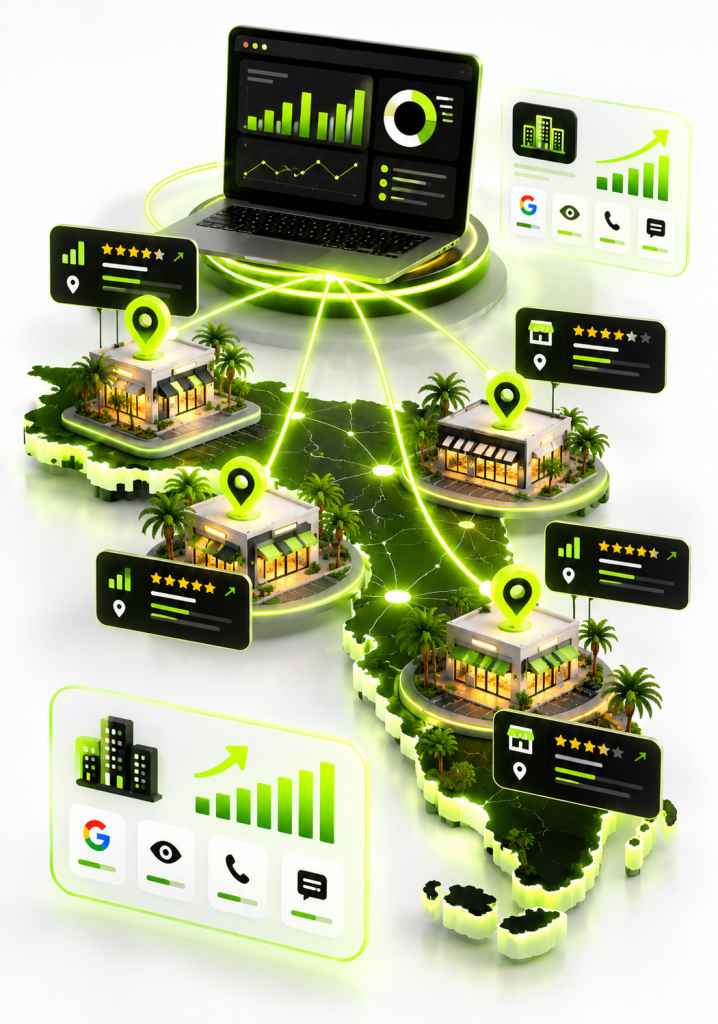
How do you measure multi location local SEO by location and for the whole brand?
Measure each location on its own. Then roll the numbers up for the brand. Compare locations with each other and with local rivals. Report problems first, not only wins.
Track local rank in the local pack. Track calls and direction requests, website clicks and form leads. Track rating count, reply time and listing accuracy. Check local rank tracking by city, not as one national number. A brand can look strong overall while one site slips.
Leaders need a one page view. Show total leads, the top and bottom locations, and fixes in progress. Local managers need their own view. Keep the names and numbers the same every month.
AEO and GEO
What does AI search mean for multi location business SEO?
AI search tools use the same pages, profiles and listings that classic search uses. Google says there are no extra requirements to appear in AI Overviews or AI Mode. Pages must be indexed and eligible for a snippet. Clear, matching location facts leave these tools less to guess.
AEO aims to be the direct answer in search results and assistants. GEO aims to be named or cited in answers from AI tools. Both start with the basics on this page. Keep key facts in plain text, keep profile details current and keep markup matching the page. No one can promise a place in AI answers.
What makes the best AI SEO agency for multi location businesses?
Look for an agency that explains its work in plain terms, names its limits and reports by location. Be careful with promises about AI answer placement, because no one controls that. Ask who does the work, how often you will hear from them and how results are measured. Ask for a clear scope for each service, named people and sources for every claim.
Our process
Which SEO strategies for multi location businesses should come first?
Fix the base first. Clean your list of locations, match your details everywhere and claim every profile. Then improve site structure and page content. Then track results by location. A good multi location SEO strategy follows this order because each step depends on the one before.
01.
List every location with exact details.
02.
Claim and verify every profile.
03.
Match details across listings.
02.
Build and improve each page.
03.
Collect and answer customer feedback.
04.
Track by location and fix the weakest first.
Pricing
SEO Pricing for Multiple Business Locations
Get a tailored SEO plan for every business location. Our pricing is based on the number of locations, competition, and the services needed to improve local visibility, attract qualified customers, and grow your brand across multiple markets.
BASIC
$499 /month
For small local businesses that need a stronger presence in local search.
- Google Business Profile Optimization
- Local SEO Optimization
- Keyword Research & Tracking
- NAP & Citation Cleanup
- On-Page SEO — 5 Pages
- 2 GBP Posts / Month
- Monthly SEO Report
PROFESSIONAL
- Popular
$799 /month
For growing businesses ready to generate more traffic, visibility, and leads.
- Everything in Basic
- Technical SEO Optimization
- On-Page SEO — 10 Pages
- 2 SEO Blogs / Month
- 2–3 Quality Backlinks / Month
- AEO & GEO Optimization
- Google Business Profile Management
- Monthly SEO Strategy
STARTUP
$1,199 /month
For competitive businesses that need a stronger search and AI presence.
- Everything in Professional
- On-Page SEO — 15 Pages
- 4 SEO Blogs / Month
- 4–5 Quality Backlinks / Month
- Advanced Technical SEO
- Advanced AEO & GEO
- Local Landing Page Optimization
- Competitor & Content-Gap Analysis
- Bi-Weekly Monitoring
FAQ's
Frequently Asked Questions
Start with a clean list of every location and its exact details. Then build one strong page for each location, claim and verify every profile, and keep details matching everywhere. Track results by location and fix the weakest ones first. This is how to do local SEO for multiple locations. The sections on this page walk through each step in order.
Plan each market on its own. Study the rivals near each location, set page and profile goals for that market, and track results by city. Share the brand rules, not the plan. A brand can lead in Miami and trail in Tampa.
Treat each business as its own brand. Give each one its own site or pages, address, phone number and profile. Write different content for each. Do not share listings or copy text between them. Link them only when it helps customers.
Yes. Every location that serves customers needs its own page with its own address, hours, services and photos. One shared page cannot hold the details of many sites. A single locations page works only as a hub that links to the rest.
Duplicate content happens when pages repeat each other. Google says it picks one version to show when several pages match. You may not like its pick. Write each page from real facts about that site. Use canonical tags only for true copies of one page, never to merge different locations.
Give each location its own job. Assign different neighborhoods, services and local details to each page. Link nearby locations to each other when it helps visitors choose. Check which page ranks for each search. Fix the page that loses to a sibling.
Yes, if the location is a real place where customers visit and your team works during stated hours. Google allows one profile for each physical location. Mailboxes and virtual offices do not qualify. Practitioners and departments follow their own rules.
It depends on scope, and more locations raise the cost. Ahrefs surveyed 439 SEO providers and published the results in December 2023. Local SEO averaged about $1,557 a month, and about 78% billed monthly retainers. Each extra location adds profiles, pages and reporting. Ask any provider for a written scope before you compare prices.